
This article was first published as the 17th edition of the LOVE /: RAGE LinkedIn newsletter (www.linkedin.com/newsletters/love-or-rage). A German-language newsletter about how we transform (digital) experiences from RAGE to LOVE!
It is the first of four LOVE /: RAGE issues diving deeper into the four dimensions of the CARE Check (Cognitive, Responsible, Accessible, Ethical). CARE is an ethical website check based on the DSA and BSFG, psychologically sound and practical to implement – a new service developed by BIRD UX.
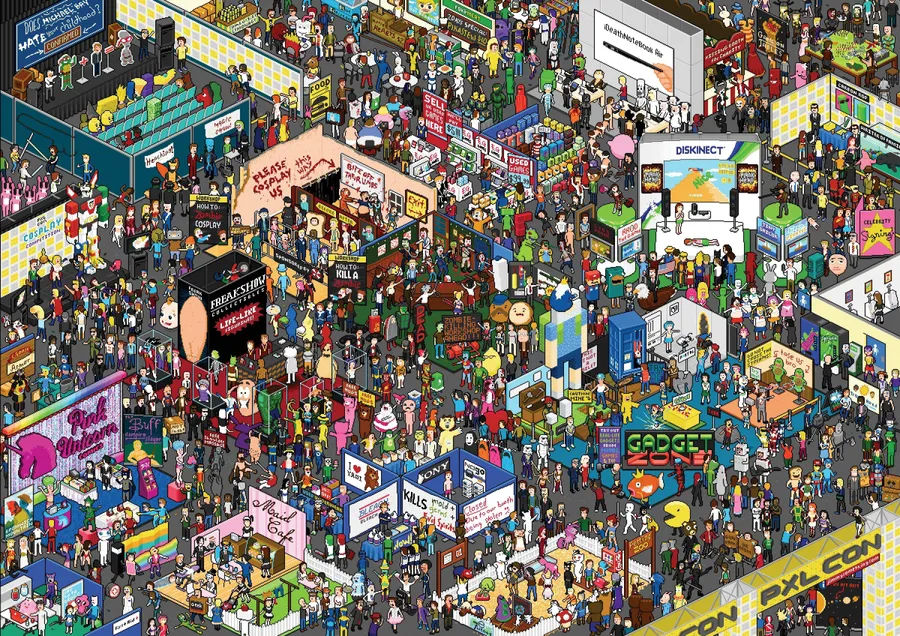
Sigh, hidden picture puzzles!
Do you remember hidden picture puzzles? You could spend whole afternoons playing them! Discovering situations, imagining stories and finding something new time and time again – dreamy. But there is a time and a place for hidden picture puzzles.
When websites or digital processes are so cluttered that they resemble hidden picture puzzles, they may well invite you to dream – but of nightmares. This is because people generally engage with digital products in order to find specific content or complete tasks. In this context of use, they are looking for guidance, not distraction, as is the case, for example, when playing hidden picture puzzles. On websites, therefore, clutter does not lead to fun, but to feeling overwhelmed. In this case, we speak of cognitive load.
What is cognitive load?
Digital products only work if they align with the way people think, perceive and make decisions. Design that respects the limits of human cognition reduces mental strain and makes complex content usable in the first place. Design that does not take the limits of human cognition into account leads to an overload of memory capacity (cognitive load), which can result in confusion, errors and, ultimately, the abandonment of processes.
However, this overload is not just about visual overload, as in our hidden picture puzzle example. According to Cognitive Load Theory (Chandler, P., & Sweller, J.), there are various forms of cognitive load:
- Intrinsic Load (content complexity) describes the inherent, real complexity of topics (e.g. the ordering process for a customisable product). This load is unavoidable and a harsh reality we must deal with.
- Extraneous Load (unnecessary additional load) describes an unnecessary additional cognitive load that does not stem from the complexity of a topic, but arises solely from design decisions or the absence of such decisions (e.g. when information is missing from an ordering process, yet people need it to make an informed decision or provide the correct details).
- Germane Load (meaningful cognitive load) describes the learning-related load, i.e. the part of the cognitive load that is necessary for the learning process and which, when encouraged, enables the targeted construction of schemata/mental models in working memory or the retrieval of existing mental models (e.g. familiar patterns for navigation, searching, donation forms), which simultaneously keeps both intrinsic and Extraneous Load low.
The link between cognitive load and error rates, and what this means for your digital products
First, the bad news:the more sensitive the context, the more detrimental the consequences of high cognitive load. If, for example, people become overloaded during a payment or donation process, there is a high probability that they will abandon it. The risk of them making a mistake or suboptimal decisions is simply too high. As if the loss of the failed transaction weren’t bad enough for us, another possible consequence is a loss of trust. A double whammy of 💩, so to speak. So how do we deal with these different types of load?
Accept Intrinsic Load
If we want to – or need to – facilitate complex processes online, we must be aware of and accept the Instrinsic Load these entail. This form of load simply exists, and we can manage it, for example through good structuring and pacing of content. Breaking long processes down into multi-stage steps that are comprehensible to people (e.g. personalising the order in step 1, entering the address in step 2, etc.) is one way in which good experience design typically deals with this. Providing useful and appropriate help texts is another. These are all learned patterns (thanks to Germane Load) that we can make use of and that can keep the error rate low.
Minimise Extraneous Load
Unlike Instrinsic Load , Extraneous Load is self-inflicted and a consequence of e.g. overloaded, unstructured processes that have either been designed or not designed. This type of load is avoidable and can always exist, even in seemingly less complex processes. Imagine, for example, a simple contact form with 5 input fields. Easy, right? Not if none of the input fields tells you what kind of information should go in the field (e.g. name, email address, message, phone number) and you can’t submit the form until the correct content is in the correct field [insert sound effect 🚿👵🏼🔪 Psycho, Shower Scene https://youtu.be/HCpRt-3SMWE?si=n3v55G2HSpmma9wz]. The potential error rate in this example is incredibly high, and people would – quite rightly – abandon the process.
Leverage Germane Load
Everyone brings knowledge and expectations – so-called mental models and schemas – with them when they start an interactive process. They have certain expectations, such as how an ordering process typically works. We can make use of this so-called Germane Load by designing in line with these expectations. We can also use Germane Load to form new schemas or mental models – e.g. by using consistent patterns that users anchor in their long-term memory. A successful example of schema formation is the hamburger menu (☰). Whilst many people initially wondered what these three horizontal lines meant, it has now become an established mental model that most people immediately recognise as a menu (https://www.nngroup.com/articles/hamburger-menu-icon-recognizability/).
In summary, if we accept Intrinsic Load , minimise Extraneous Load and specifically promote Germane Load , we are well on the way to ensuring that people are not overwhelmed by the content in our digital processes and on our websites. But how do we even know if our designs have a cognitive load problem?
Is cognitive load preventing successful conversions in your digital products?
If you’re now wondering whether cognitive load is a root cause of problems on your site or in your digital processes, you can find clues by, for example, observing people as they use your site. This doesn’t have to take the form of a sophisticated usability test. Grab some colleagues, acquaintances, friends or family members and ask them, for example, to find a specific piece of content on your site or to go through a process (donation, registration, login, you name it). Then keep an ear out for tell-tale soundbites (e.g. “Do I have to fill all this in?”, “Where can I find…”, “What was that called again?”, “What have I done wrong now?”). Facial expressions are also a good indicator. Examples include 😳, 🥵, 🫠. If this sounds or looks familiar, it could be down to cognitive load.
Your digital product is overwhelming people – what now?
Now that you’re aware of the issue, you can review and optimise your pages and processes. Keep the mantra “Accept intrinsic load, minimise extraneous load, leveraging germane load” in mind.
Alternatively, you can have a look at our new audit service, which we’ve developed specifically for this scenario: the CARE-Check. The CARE-Check shows you how your website or app really works – not just technically, but for real people. You can find out exactly what the term CARE means here: https://birdux.studio/en/services/ethical-website-audit/
Did you find this content helpful? The German-language LOVE /: RAGE LinkedIn newsletter is published monthly on LinkedIn and can be subscribed to there: www.linkedin.com/newsletters/love-or-rage