This article is published in a similar form as the 18th edition of the LOVE /: RAGE LinkedIn Newsletter – the German-language newsletter about how we turn digital experiences from RAGE to LOVE.
This is the second part of our article series exploring the dimensions of our CARE Check (Cognitive, Responsible, Accessible, Ethical). The last edition covered Cognitive Load. Today, we turn to the Accessible dimension.
Who Is Your Website Excluding Right Now – Without You Even Knowing?
Imagine someone wants to donate to a foundation. Not much – twenty euros, because they believe in the work or because it affects them personally. This person has a mild tremor. No diagnosis, no care assessment, just hands that sometimes don't quite cooperate.
The donation page looks clean. The buttons are slim and elegant. The person taps "Continue". Lands on "Cancel". Tries again. Misses again. On the third attempt it works – but now they're out of the flow, a little frustrated, a little uncertain. They close the page. And don't donate.
The button looked great in the UI design. Nobody made it small on purpose. And that is precisely the problem.
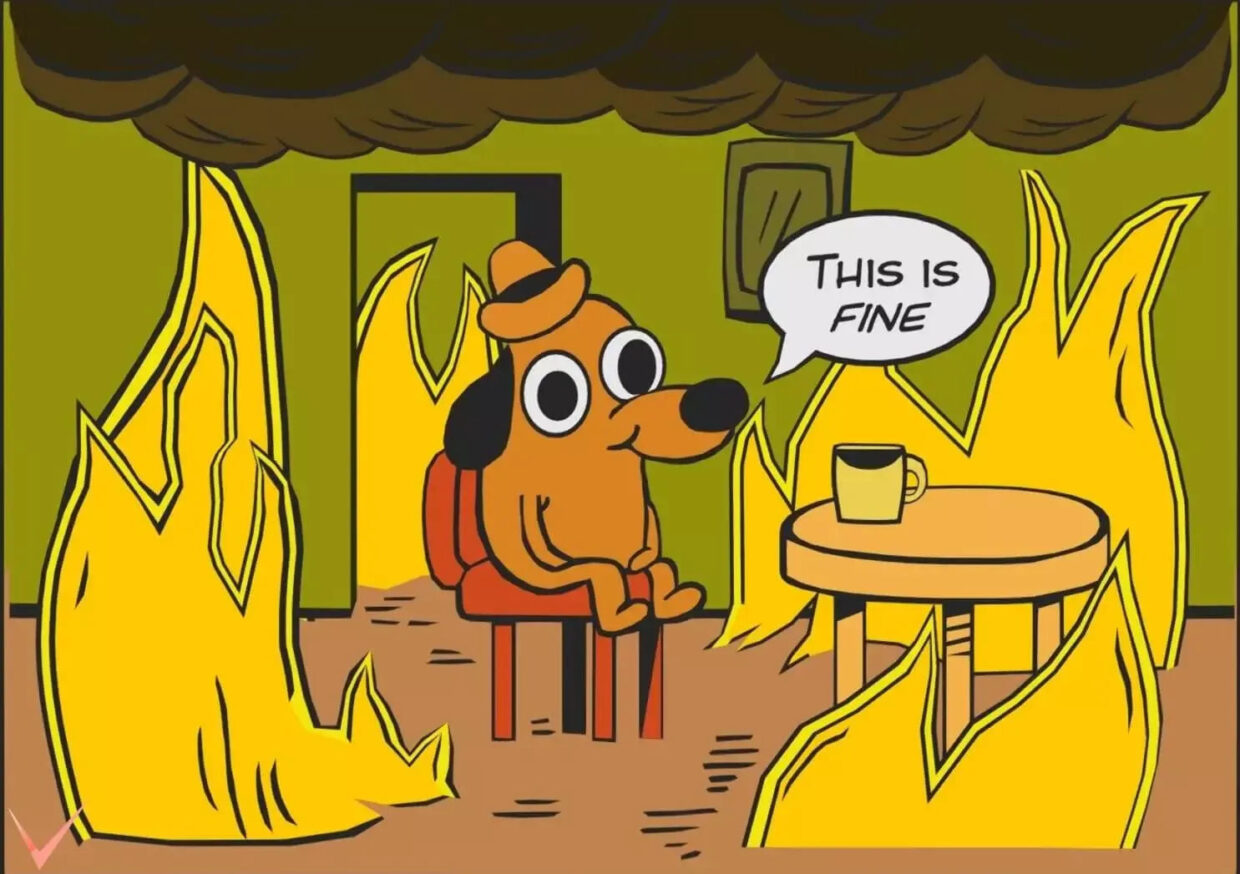
"This Is Fine" meme originated from the webcomic Gunshow by KC Green; strip "On Fire“, 2013
What Accessibility Really Is – and What It Isn't
Most people assume accessibility is a legally required add-on for a small minority. This misconception persists – and it is simply wrong.
According to the WHO, around 1.3 billion people worldwide live with a disability. That is approximately 15 to 16 per cent of the global population. On top of that, there are people who are temporarily impaired (broken arm, ear infection), situationally limited (glaring sunlight on a phone screen, a noisy environment) or simply getting older..
A classic example: subtitles were developed for Deaf and hard-of-hearing people. Today, around 80 per cent of all viewers switch them on – on the tube, during a lunch break, while falling asleep.
This is known as the Curb-Cut Effect: dropped kerbs were introduced for wheelchair users. Today, parents with pushchairs, cyclists, and delivery drivers rely on them every day. The same principle applies in the digital world: Accessibility is usability – for everyone.
And there are clear, regularly updated standards that define what this means in practice: WCAG – Web Content Accessibility Guidelines
Why Accessibility Barriers in Digital Products Stay Invisible
The tricky part: accessibility barriers are often simply invisible to those who aren't affected.
- Those with good eyesight don't notice when contrast is too low or text too small.
- Those without colour blindness don't realise that status indicators relying solely on red and green are unreadable for many users.
- Those working with a mouse have no idea how laborious it is to navigate a website using only a keyboard.
In practice, this means accessibility questions tend to surface only when a legal complaint is already looming or an audit has failed. And yet the landscape has been clear for some time.
Accessibility Has Been a Legal Requirement Across Europe Since June 2025 – Including for NGOs and Universities
The European Accessibility Act (EAA) (https://commission.europa.eu/strategy-and-policy/policies/justice-and-fundamental-rights/disability/european-accessibility-act-eaa_en) has been EU law since 2019 – but its requirements became enforceable on 28 June 2025. Since that date, digital products and services within scope must comply. It applies across all EU member states and requires that digital products and services meet accessibility standards – including those offered by private organisations.
For NGOs, universities, and values-driven organisations, this means: those without a prioritised roadmap are now at risk of legal action, reputational damage, and – worst of all – a loss of trust among the very donors and stakeholders whose support they depend on. If you are based in the UK, the equivalent framework is the Public Sector Bodies Accessibility Regulations (PSBAR) alongside the Equality Act 2010, which requires reasonable adjustments for disabled users. While private organisations outside the public sector are not yet subject to the same mandatory standards as in the EU, the direction of travel is clear – and best practice now means building accessibility in from the start.
The Real Cost of Poor Accessibility
Beyond legal risk, poor accessibility has a direct impact on the effectiveness of your digital channels. Here is where the costs show up:
- Conversion drops – as in our opening example: users give up before they donate, book, or apply.
- Trust erodes – when someone struggles on a poorly accessible site, they question the professionalism of the organisation behind it.
- Support requests increase – questions that an accessible product would have made unnecessary end up in your inbox.
- Reach goes untapped – not just among people with disabilities, but among everyone who is situationally limited.
A proactive approach to accessibility is not only more humane. It is also more cost-effective.
Is Poor Accessibility Preventing Successful Outcomes on Your Website?
There are hundreds of tools – the majority free – that can help you identify where accessibility issues exist in your digital products. The Web Accessibility Initiative has a curated list here: WAI Evaluation Tools
But: scanning away, generating an endless list of errors, and then frantically trying to work through them – that is how you end up with a PDF graveyard. The report sits in a drawer because nobody has the time or capacity to act on it.
A Pragmatic Start to Accessibility – Without the Overwhelm
The starting point does not need to be perfect. It just needs to be a start.
If you are engaging with accessibility for the first time, it is far more effective to understand and implement a few things properlythan to receive a full WCAG report that overwhelms – and therefore gets quietly ignored.
Understanding is key: once you grasp why something creates a barrier, you can apply that lens to future design and development decisions from the outset. This is what Shift Left means in practice – embedding accessibility early in the process, not as a last-minute check before launch.
The Accessible dimension of our CARE Check is built for exactly this. Rather than a purely technical WCAG compliance procedure, we take a UX-led look at the barriers that have real, immediate impact – most of which can be addressed without placing excessive demands on your development team. We work to WCAG 2.1 Standard, Level AA – the legally relevant standard for digital accessibility in Europe.
What you get: not an endless fault list, but a prioritised roadmap with quick wins – and the documentation you need to present to your board or stakeholders.
👉 Find out more about the CARE Check
Frequently Asked Questions About Accessibility
Does the European Accessibility Act apply to our NGO? Yes – the EAA has applied since June 2025 to private providers of digital products and services across the EU, which includes many NGOs and non-profit organisations. Whether and to what extent your organisation is affected depends on your size and the nature of your offering. A first audit will give you clarity.
What is the difference between WCAG 2.1 AA and full accessibility? WCAG 2.1 Level AA is the legally relevant standard in Europe. It covers the key requirements around perceivability, operability, understandability, and robustness. Full accessibility in an absolute sense is an ongoing process – but meeting this standard gives you the necessary, demonstrable framework.
Do accessibility overlays work as a quick fix? No. The consensus across the accessibility community is unambiguous: overlay widgets do not fix underlying code issues. They can even actively interfere with screen reader users. Sustainable accessibility requires changes directly within the product.
Where do I start if my team has no capacity? This is exactly where a pragmatic approach helps: not everything at once, but prioritised quick wins that show immediate impact – without overloading your development team.
Found this useful? The LOVE /: RAGE Newsletter is published in German monthly on LinkedIn. www.linkedin.com/newsletters/love-or-rage